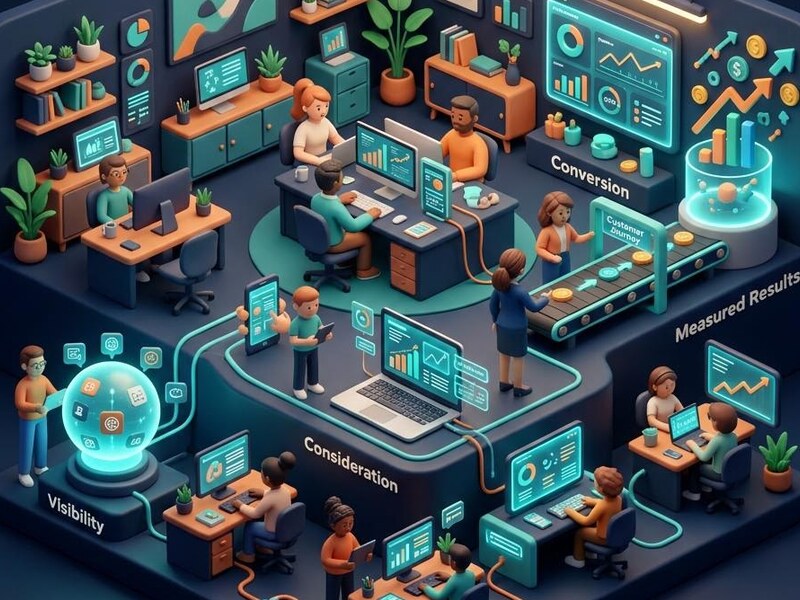
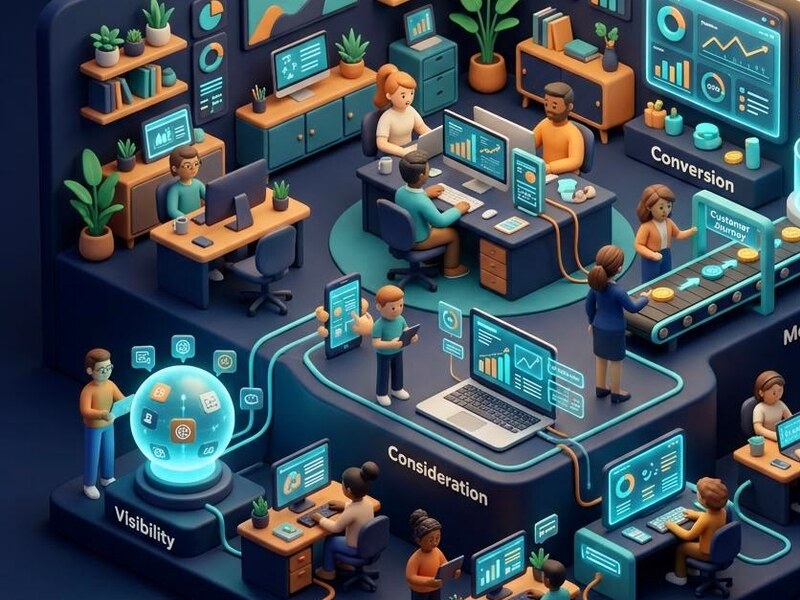
Find the audienceEarn attentionConvert interestContinue the conversation
01 / The bigger picture
Not more channels. A more connected system.
A connected view of how marketing activity supports customer journeys, sales follow-up, and business goals, with clear evidence to inform the next decision.
Roaring Media’s Digital Marketing Program brings strategy, website and conversion work, search, paid media, social and content, lifecycle communication, automation, and measurement into one coordinated operating plan. We begin with your business, customers, sales process, current marketing, and growth priorities, then shape the channels and work around what is relevant to your situation.
We review the business and its growth objectives alongside customer and audience information, competitive context, offers, sales process, current digital presence, technology, historical performance, and available conversion data. The Digital Marketing Blueprint turns those findings into a practical basis for audience, message, channel, and measurement choices.
We connect the customer journey across the channels that fit the engagement. That can include website and conversion improvements, SEO, paid acquisition, social and content, email and SMS, CRM alignment, and automation. The mix, sequencing, and level of support depend on business priorities, existing resources, technology, and available data.
03 / Inside the program
The disciplines, in concert.
Depending on agreed scope, work may include strategy, campaign and content planning, landing experiences, channel execution, tracking, CRM workflows, and team coordination. Roaring Media can act as an integrated digital marketing department or work in partnership with internal marketing and sales staff.
01 / 11
Start with a Digital Marketing Blueprint
Before choosing channels, we build a working picture of the business and its customers. The Blueprint helps answer who to reach, what to communicate, and how attention can connect to measurable business activity.
Business and market context
Review growth objectives, customer economics, competitors, offers, current marketing, and the sales process.
Audience and journey
Develop or refine customer profiles, targeting considerations, and the steps people take from discovery to purchase and retention.
Positioning and channel choices
Clarify messages and evaluate channels, technology, prior performance, conversion evidence, and relevant KPIs.
02 / 11
Make the website a useful next step
The website and campaign destinations should help visitors understand the offer and take an appropriate action. Depending on the work identified, we review structure, mobile experience, navigation, page speed, messaging, trust signals, forms, calls to action, analytics, and conversion paths.
Improve key journeys
Examine the path from entry page to inquiry, appointment, purchase, or another agreed conversion event.
Create focused landing experiences
Where useful and in scope, develop pages for a particular offer, service, location, audience, or campaign.
Use conversion evidence
Assess visitor behavior and conversion points rather than treating traffic volume alone as the measure of progress.
03 / 11
Build organic visibility with SEO
SEO work can connect technical foundations and search intent with the questions, services, and products prospective customers look for. The focus is not rankings in isolation, but the relationship between search visibility, useful visits, and business-relevant actions.
Technical and site foundations
Assess crawlability, indexing, site architecture, internal links, schema, and relevant technical issues.
Search intent and content
Research topics and queries, improve existing pages, and plan useful content around customer needs and competitive gaps.
Local search when relevant
Consider location pages, local search presence, and supporting information for businesses serving defined areas.
04 / 11
Coordinate paid acquisition
Paid media may include search, display, video, social, retargeting, or local campaigns when they suit the audience and objectives. Campaign planning connects targeting and creative to landing experiences, tracking, budget decisions, and lead-quality feedback.
Plan the campaign
Set campaign structure, audience or keyword approach, creative direction, and budget parameters based on the agreed plan.
Connect ads to action
Align ad copy and creative with relevant landing pages, conversion events, and tracking.
Review useful signals
Evaluate available measures such as cost, conversion rate, lead quality, pipeline, or revenue, as tracking permits.
05 / 11
Use social and content across the journey
Social and content can support discoverability, education, consideration, conversion, retention, and advocacy. Content plans are shaped for the channels and audiences in scope, and may connect organic publishing with paid amplification where appropriate.
Platform-aware social
Plan calendars, educational or promotional posts, short-form video concepts, customer stories, and community engagement to fit selected platforms.
Content for customer questions
Depending on scope, develop or plan pages, articles, guides, FAQs, case studies, email content, video scripts, or sales-enablement materials.
Reuse with purpose
Adapt useful themes across SEO, social, campaigns, and sales conversations without assuming every format is right for every channel.
06 / 11
Continue the conversation with lifecycle marketing
Email and SMS can support communication after an inquiry or purchase, using consent, customer context, and available CRM data to make messages more relevant. Automation and AI are considered only where the use case, technology, and safeguards fit.
Lifecycle communication
Potential use cases include welcome and nurture sequences, appointment reminders, quote follow-up, onboarding, reactivation, renewal, review, and referral messages.
Connected workflows
Where agreed and supported by the technology stack, workflows may handle lead routing, sales notifications, scheduling, scoring, or reporting tasks.
Context-dependent AI
AI-assisted content, conversational experiences, or lead qualification may be explored when appropriate, with clear human ownership and review.
07 / 11
Connect funnels, local presence, and reputation
Acquisition is planned as a customer path rather than a stand-alone ad. For locally oriented businesses, local visibility and reputation activity can be part of that path; the approach varies with locations, systems, and agreed responsibilities.
Map the funnel
Connect relevant stages such as audience discovery, search or advertising, landing page, conversion, CRM follow-up, sales opportunity, customer, and retention.
Support local discovery
Where relevant, consider Business Profile information, location pages, citations, geographic targeting, map visibility, and localized content.
Support customer advocacy
Review requests, feedback monitoring, testimonials, referrals, and internal escalation paths may be considered within agreed scope.
08 / 11
Align marketing with CRM and sales
A lead’s path does not end when a form is submitted. Connecting campaign context to CRM stages and sales follow-up can help teams see what happens next and identify where handoffs or tracking need attention.
Agree on lifecycle stages
Define relevant qualification criteria, ownership, routing, and sales notifications with the people handling inquiries.
Keep campaign context
Use source and campaign tracking, where available, to relate marketing activity to leads and subsequent pipeline stages.
Learn from sales outcomes
Use follow-up status, lost opportunities, and closed revenue when accessible to inform marketing decisions.
09 / 11
Measure what the data can support
A measurement plan should make the customer journey and data limitations understandable. The tools and reporting depend on the engagement, existing setup, and the events that can be tracked reliably.
Establish tracking
Use suitable analytics, advertising, CRM, call-tracking, and attribution tools where available and appropriate.
Report across stages
Depending on access and scope, follow traffic and engagement through leads, qualified leads, appointments, opportunities, customers, revenue, or retention.
Make assumptions visible
Distinguish observed data from estimates and document gaps that limit channel or revenue attribution.
10 / 11
Optimize continuously and responsibly
Marketing is reviewed after launch, not treated as a one-time deployment. Testing and changes are selected from evidence, operational capacity, and the agreed priorities; activity that is not useful can be revised, replaced, or stopped.
Review the whole path
Assess audiences, search terms, creative, offers, landing pages, forms, lead quality, follow-up, and downstream outcomes as data allows.
Test relevant variables
Potential tests include headlines, calls to action, page layouts, audience segments, bids, and email subject lines or sequences.
Revisit investment choices
Use observed performance and business context to inform which approaches to continue, adjust, or expand.
11 / 11
Operate as one department or alongside yours
Roaring Media’s Digital Marketing Program is the coordinated umbrella above related programs such as SEO, paid media, web development, AI automation, and Mobile CMO. Those disciplines can be engaged independently or brought together where useful. Roaring Media can coordinate the operation or collaborate with internal teams, with roles and scope defined for each engagement.
One connected plan
Bring selected specialists and channels into a shared strategy, customer journey, and measurement conversation.
Flexible collaboration
Coordinate with in-house marketing and sales staff or provide a more integrated outsourced department model, as agreed.
04 / The operating rhythm
Follow an eight-stage growth framework
The operating cycle gives the team shared stages for planning, delivery, learning, and customer retention. The sequence is revisited as business needs and evidence change.
01 / 08
1. Discover
Understand the business, customers, competitors, economics, current marketing, and growth objectives.
02 / 08
2. Strategize
Set positioning, audiences, offers, channel choices, campaigns, budgets, funnels, and KPIs.
03 / 08
3. Build
Develop the agreed campaigns, content, creative, landing experiences, tracking, CRM workflows, and automation.
04 / 08
4. Launch
Deploy coordinated work across the selected digital channels.
05 / 08
5. Measure
Track activity through leads, opportunities, customers, and revenue where the data supports it.
06 / 08
6. Optimize
Test and refine audiences, messaging, creative, offers, funnels, and conversion experiences.
07 / 08
7. Scale
Consider expanding investment in approaches showing suitable evidence and operational fit.
08 / 08
8. Retain
Continue the customer relationship through relevant lifecycle, cross-sell, referral, and reactivation activity.
05 / From activity to evidence
See what happens after the lead.
Organizations that need multiple digital disciplines to work together, whether Roaring Media leads the marketing operation or collaborates with an existing in-house marketing and sales team.
Analytics, attribution & reporting
Measurement is planned around the customer and sales journey, using available analytics, advertising, CRM, and other relevant data. Reporting can connect channel activity with leads, lead quality, appointments, opportunities, customers, revenue, or retention where those events can be tracked; assumptions and data limitations are made visible.
Program capabilities
Digital Marketing Blueprint & Channel StrategyWebsite, Landing Pages & Conversion OptimizationSEO & Local SearchPaid Media & Acquisition FunnelsSocial Media & Content MarketingEmail, SMS & Lifecycle MarketingMarketing Automation & Context-Dependent AICRM, Sales Alignment & AttributionAnalytics & Continuous Optimization
06 / An ongoing practice
Measure. Learn. Refine.
Depending on agreed scope, work may include strategy, campaign and content planning, landing experiences, channel execution, tracking, CRM workflows, and team coordination. Roaring Media can act as an integrated digital marketing department or work in partnership with internal marketing and sales staff.
07 / Explore the connected work
Go deeper in one discipline.
Each service can operate independently or as part of the complete digital marketing program.
What is included in the Digital Marketing Program?
It is the coordinated umbrella above relevant digital disciplines, including strategy, website and conversion work, SEO, paid media, social and content, lifecycle communication, automation, CRM alignment, and measurement. The actual channel mix and deliverables are agreed around your needs, systems, and engagement scope.
Can you work with our in-house team?
Yes. The program can be structured as an integrated outsourced marketing department or as collaboration with your existing marketing and sales team. Roles, decision-making, and handoffs are set for the engagement.
Do you use AI and automation for every client?
No. Automation and AI are considered in context of your customer experience, workflows, technology, data, and controls. When appropriate, they may support tasks such as routing, follow-up, or content workflows; they are not included by default.
How is performance measured?
Measurement is tailored to available tracking and business objectives. Depending on the engagement, reporting may follow activity through qualified leads, appointments, opportunities, customers, revenue, or retention, while noting gaps in attribution or data.
Does the program guarantee a particular result?
No specific result is guaranteed. Channel availability, timing, deliverables, and measurement depend on the agreed scope, market, existing systems, and data. The work includes reviewing evidence and making informed adjustments.
The next useful conversation
Bring the whole picture into focus.
Tell us where your marketing stands today. We will talk through how its parts can work together.